

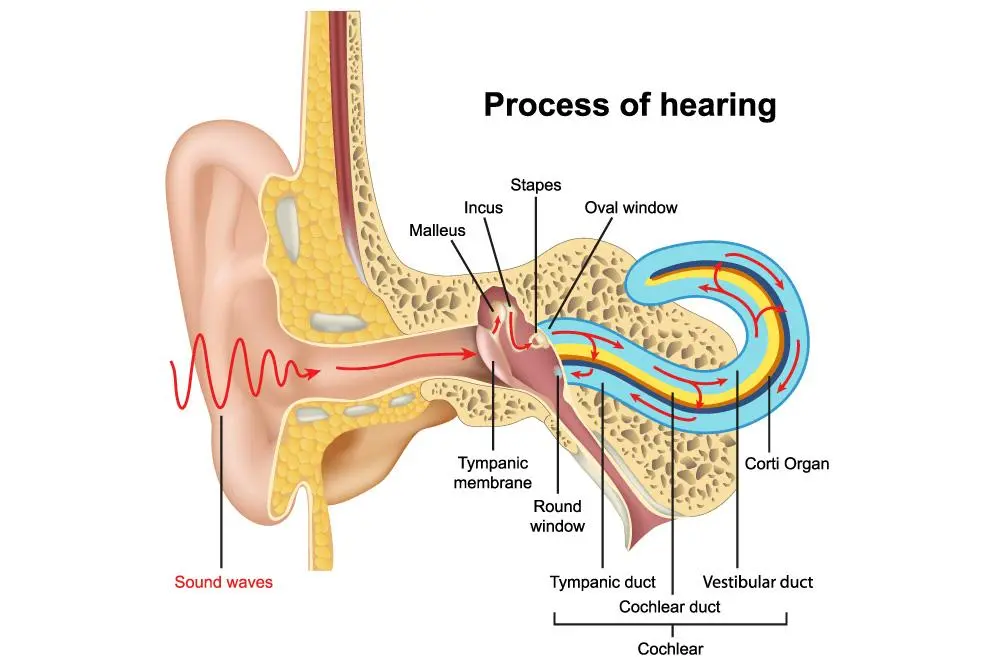
 The ear is divided into three parts; the external ear, the middle ear, and the inner ear. The external ear collects sound, the middle ear mechanism transforms the sound and the inner ear receives and transmits the sound.
Sound vibrations enter the ear canal and cause the eardrum to vibrate. Movements of the eardrum are transmitted across the middle ear to the inner ear fluids by three small ear bones. These middle ear bones (hammer or malleus, anvil or incus and stirrup or stapes) act as a transformer changing sound vibrations in air into fluid waves in the inner ear. The fluid waves stimulate delicate nerve endings in the hearing canals. Electrical impulses are transmitted on the nerve to the brain where they are interpreted as understandable sound.
 The external ear and the middle ear conduct sound; the inner ear receives it. If there is some difficulty in the external or middle ear, a conductive hearing impairment occurs. If the trouble lies in the inner ear, a sensorineural or nerve hearing impairment is the result. When there is difficulty in both the middle and the inner ear a mixed or combined impairment exists. Mixed impairments are common in otosclerosis.
 There are no medicines that can correct or prevent the conductive type hearing loss of otosclerosis. However, treatment with a fluoride medication may be used in the patient who is developing nerve-type hearing loss related to otosclerosis. Fluoride in moderate doses has been shown to inactivate the toxic chemicals of the abnormal otosclerotic bone that are toxic to the hearing nerves. It does not recover any nerve loss or improve any tinnitus that has already occurred but can prevent its worsening. However, it must be taken in moderate doses for at least one to two years until the progression of nerve loss has stopped, and thereafter in smaller doses indefinitely. This medicine should not be used in any individuals of child-bearing age and has several other potential risks.
A hearing aid can be effective in treating the hearing loss related to otosclerosis in the majority of patients whether it is nerve or conductive. Whether or not a hearing aid is the best option for you is an individual decision between you and your doctor.